In memoriam: Prof. William “Bill” Jones
Lafayette College offers its deepest sympathy and condolences to the family, friends, and colleagues of William “Bill” Jones, Professor Emeritus of Mathematics, who died Aug. 8 in Cohoes, N.Y., at the age of 94. A mathematician, teacher, and lifelong learner, Jones spent more than three decades on the Lafayette faculty, serving from 1963 until his retirement in 1994, and continued his mathematical work long after his retirement.
Jones began his college education at Glassboro State Teachers College, where he met fellow student Elizabeth “Betty” Pedersen, who would become his wife and lifelong companion. Both continued on to graduate study: he at Rutgers University, where he earned master’s and doctoral degrees in mathematics. His dissertation in analysis (of which calculus is the first step) examined boundary problems of ordinary differential equations. Betty studied at Columbia University and Temple University, and pursued her own career in psychology.
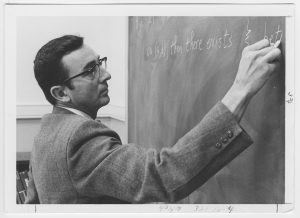 In 1963, Jones joined the faculty of Lafayette College. Over the next 31 years, he taught generations of Lafayette students, bringing to the classroom a patient manner, a keen intellect, and a deep love for mathematics. Following his retirement in 1994, he was named Professor Emeritus of Mathematics.
He published several papers throughout his career in the Journal of Differential Equations, American Mathematica Monthly, Mathematics Magazine, Two Year College Mathematics Journal, and Notices of the American Mathematical Society. During a sabbatical leave in 1976-1977, he studied existence and uniqueness theorems for differential equations and delved into the field of nonstandard analysis. During other leaves he delved into the computer language APL and made a foray into social choices theory, studying the simulation and investigation of elections by computer.
Jones had a long-standing interest in computational mathematics and in the use of computer programming languages to explore and teach mathematical ideas. In 1990, he and his Lafayette colleague Clifford A. Reiter published APL with a Mathematical Accent, a textbook introducing the APL programming language through its mathematical applications. His intellectual curiosity continued well into retirement. He remained interested in mathematical computing and the J programming language, and continued to collaborate with Reiter, including on “Observations at the J User Conference” in 1996 and “Cauchy Curves,” published in Vector in 2008.
Outside mathematics, Jones had a lifelong love of nature and travel. From hiking during his college years to camping trips across the American West with Betty and their daughters, he delighted in the beauty and extraordinary variety of the country’s landscapes. In retirement, he and Betty traveled widely abroad, exploring Europe, Australia, and China. He also loved tennis, both as a player and a spectator. For many years he played regularly with friends and colleagues at Lafayette. Although he watched relatively little television, Wimbledon was an annual exception.
Family was at the center of Jones’ life. He remained close to his large family of brothers and sisters, and was deeply devoted to the family he and Betty built together. He is survived by his daughters, Elizabeth Silver and her husband, Aaron Silver, and Kathleen Jones; his grandchildren, Timothy Silver and Caroline Silver Gibson; his sisters, Millie Brown, Barbara Kurtz, and Judy Scanlon; his brothers, Gilbert Jones, Mike Jones, Steve Jones, and Jeff Jones; and many nieces and nephews. Jones and his wife lived for many years in Easton and later Pen Argyl before moving to the Moravian Hall Square community in Nazareth. Betty died July 9, 2021, after nearly a lifetime at his side. In 2024, Bill moved to the Albany, N.Y., area to be closer to his daughters.
Jones will be remembered at Lafayette for his decades of teaching and scholarship and by those who knew him for something less easily recorded in a curriculum vitae: his kindness, curiosity, and devotion to the people he loved. His influence continues in his family, in the students he taught, and in the mathematical work that engaged and delighted him throughout his life.